
Trigger point massage, explained: what those “knots” really are

Everyone knows the spot. That one place at the top of your shoulder that’s always tight, aches when you press it, and somehow sends pain up the side of your neck or into your head. Clients point to it on the table every week: “right there — that’s the knot.” Trigger point massage is the work of finding those spots and treating them deliberately instead of just rubbing the general area. Here’s what trigger points actually are, how the work feels, where the usual suspects hide, and — in keeping with the rest of this site — what the evidence honestly does and doesn’t show.
What is trigger point massage?
Trigger point massage applies sustained, specific pressure to small, hypersensitive spots in muscle — tender points that ache locally and often refer pain somewhere else. That referral is the signature: press the right spot in your upper trapezius and you may feel it behind your eye; press a gluteal trigger point and it can run down the leg. Instead of gliding strokes, the pressure is held — typically 20 to 60 seconds — until the spot’s sensitivity fades and the tissue lets go.
It’s not a separate booking or a different modality with its own price tag. It’s a precision layer inside good clinical bodywork — the difference between vacuuming a room and picking up the one thing that keeps tripping you.
So what is a “knot,” really?
Honesty section first, because you’ll find confident-sounding explanations everywhere and the truth is messier. The classic model says a trigger point is a small patch of muscle fibers stuck in contraction — a micro-cramp that restricts local blood flow, irritates nerve endings, and refers pain in predictable patterns. That model is genuinely debated in research: the “taut band” is hard to image reliably, and some scientists argue these spots are better understood as sensitized nerve endings and protective nervous-system behavior rather than a mechanical lump.
Here’s what nobody debates: the tender spots exist, the referral patterns are remarkably consistent from person to person, and sustained pressure reliably changes them. Whether the change happens mostly in the tissue or mostly in the nervous system matters for researchers; on the table, the practical playbook is the same. I’d rather tell you “this works and we’re still learning exactly why” than sell you a tidy story. (I take the same approach in my guide to what massage therapy actually is.)
Where the most common trigger points hide
- Upper trapezius — the top of the shoulder. The single most common spot I treat, and the classic source of tension headaches that wrap up the neck and behind the eye — the pattern I cover in depth on my neck & shoulder pain page.
- Levator scapulae — runs from the neck to the top of the shoulder blade. The “I slept wrong and can’t turn my head” muscle.
- Suboccipitals — tiny muscles at the base of the skull, heavily worked by screen posture. Big players in headaches.
- Glutes & piriformis — refer pain into the hip and down the leg, and get blamed for a lot of “sciatica.”
- Quadratus lumborum — deep in the low back, a frequent driver of that one-sided low-back ache.
- Forearms — the desk worker and lifter special; refers into the wrist and elbow.
What the work actually feels like
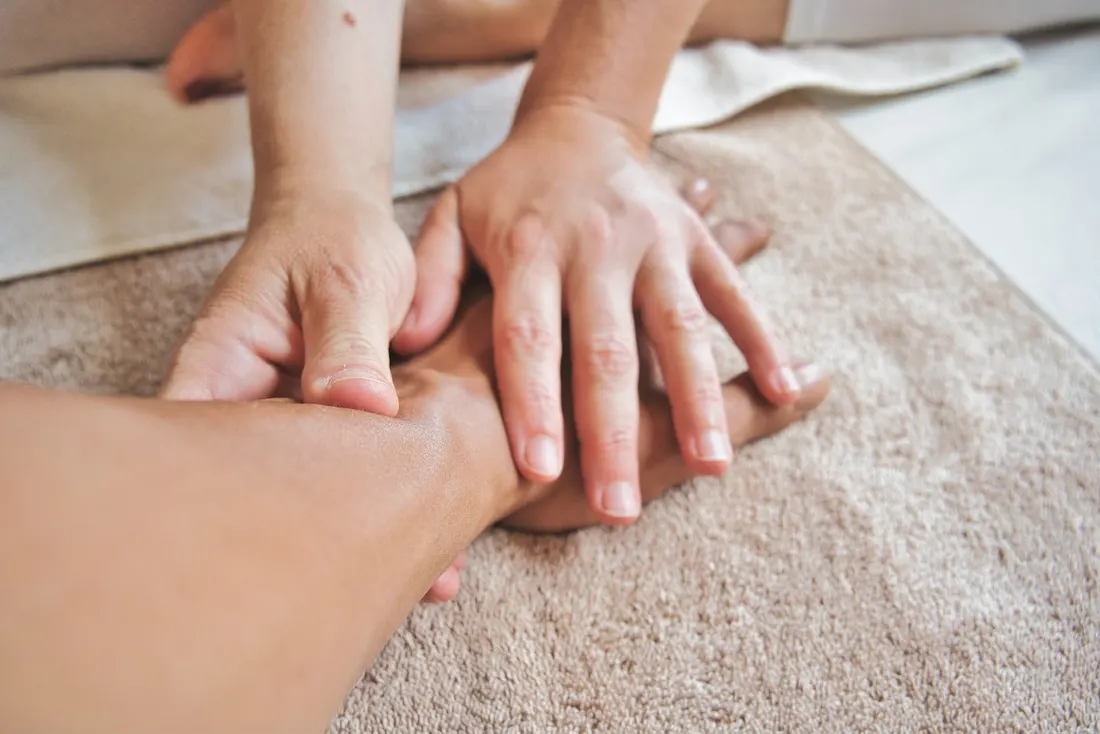
Good trigger point work has a distinct feel clients describe as “hurts good” — a strong, focused ache, often with that odd sensation of pain showing up somewhere other than where I’m pressing. That referral is confirmation we’re on the right spot, not a wrong turn.
The dosage rules I work by:
- Pressure around a 5–7 out of 10. You should be able to breathe slowly and keep the rest of your body relaxed. If you’re bracing, it’s too much — a guarding muscle doesn’t release.
- Hold 20–60 seconds, until the sensation visibly fades — usually the spot “melts” under the pressure. Several moderate passes beat one heroic one.
- Stop while it’s ahead. Grinding the same spot for five minutes leaves it bruised and angrier. If an area is more painful for more than a day or two afterward, the dose was wrong.
How do you know it worked? Same pressure, less tenderness. The referral quiets down. The area feels softer, and afterward the neck turns or the hip extends a little more freely. Mild next-day soreness — like a workout — is normal and settles quickly.
Does trigger point massage actually work?
The research, honestly summarized: moderate-quality evidence that pressure techniques reduce pain and improve range of motion in the short-to-medium term, especially for neck and shoulder pain — alongside real scientific debate about the mechanism, and no support for claims that it “breaks down” knots or scar tissue like some kind of eraser. Trigger point work is a tool that reliably changes how an area feels and moves; it is not magic, and anyone promising permanent one-session fixes is overselling.
The other honest caveat: if the cause doesn’t change, the spot comes back. A trigger point in your upper trap that formed from ten hours a day of mouse-and-monitor posture will re-form under the same load. That’s not failure — it’s maintenance, the same way training or flossing is. But it’s also why sessions with me usually pair the table work with one or two specific things to do between visits.
How this fits into a session
You don’t book “a trigger point massage” with me — you book time, and trigger point work happens wherever the assessment says it will help. It lives naturally inside deep tissue work, where sustained specific pressure is the whole vocabulary, and inside sports massage, where a stubborn spot is often what’s capping a lift or shortening a stride. When a spot guards against direct pressure entirely, decompression via cupping is sometimes the better way in.
And because the practice is mobile, all of this happens at your home, anywhere in Reading and Berks County — table, tools, and trigger point maps included.
Got a spot that always comes back?
Book an in-home session in Reading & Berks County — we’ll find what’s referring, treat it properly, and give you a plan to keep it quiet.
Book a session